
// Vinyl
The Best Way to Store 7-Inch Vinyl Records (2026 Guide)

SH, who writes this site, designs and sells the 3D printed storage boxes covered in one section below. They are marked as such, and the alternatives compared alongside them are products we have no stake in.
The 7-Inch Storage Problem Nobody Talks About
Every guide to storing records assumes you mean 12-inch LPs. Crates, shelving, sleeve recommendations — all sized for the big format. Then you start buying 45s, and none of it applies.
A 7-inch single is 17.8 cm square. Dropped into a 12-inch crate it falls over, slides sideways, and buries itself behind the LPs. So most people improvise: shoeboxes, a cardboard box from a shipping order, a drawer. That works until it does not, usually somewhere around the 80-record mark, when finding a specific single means emptying the whole container onto the floor.
The failure modes are consistent and worth naming, because they determine what you actually need:
- Records lean and warp. A partially full box lets records tilt. Left tilted for months, a 45 takes a permanent bend.
- Sleeves get shelf-worn. Loose records shift against each other every time the box moves. Picture sleeves take the damage first.
- Nothing stays in order. Without a snug fit, any sorting system collapses the first time you carry the box anywhere.
- Transport destroys cardboard. If you take 45s to gigs, a cardboard box lasts a season at best.
What Good 7-Inch Storage Actually Needs
Before comparing products, it helps to know what you are optimising for. Five things matter:
| Requirement | Why | What fails it |
|---|---|---|
| Correct internal width | Records stay vertical without leaning | Anything sized for 12-inch |
| Rigid walls | No bowing under 5–7 kg of vinyl | Thin cardboard, soft plastic |
| Open top | Flip through without unpacking | Lidded archive boxes |
| Carry-ready | Survives being moved to a gig | Assembled cardboard, brittle plastic |
| Visible contents or labelling | Find the right box at a glance | Identical opaque boxes |
Capacity is the one thing people over-index on. A box holding 50 records is more useful than one holding 150, because a full 150-count box of 45s weighs enough that you will stop moving it — and boxes you never move are boxes you never dig through.
The Options, Compared
Cardboard 45 boxes ($10–20)
The standard entry point, sold by most record suppliers. Correctly sized, cheap, and stackable. They also sag once full, absorb humidity, and tear at the handles within a year or two of regular use. Fine for archive storage in a dry room; poor for anything you carry.
Repurposed household containers ($0–15)
Shoeboxes, plastic food containers, drawer inserts. Free, and genuinely fine for a first 50 records. The problem is width — almost nothing off the shelf is 18 cm internally, so records either lean or wedge. Test with a record before committing a collection to one.
Wooden 45 crates ($40–90)
Solid, attractive, and heavy. The right choice for a permanent listening-room setup where the box stays put. Not the right choice for transport: a full wooden crate of 45s is a genuinely awkward carry.
Purpose-built DJ cases ($60–150)
Flight-case style, foam-lined, latching. Built for the road and effectively indestructible. The trade-offs are weight, price, and that closed cases are slow to dig through — you are unpacking rather than flipping.
Small-batch 3D printed boxes ($60–80)
The newer category, and the one worth explaining in detail since it is least familiar.
Hands-On: 3D Printed 7-Inch Storage Boxes
Full disclosure: these are ours. SH designs and sells them. The comparison table above is the honest place to start — if one of the cheaper options fits how you actually store records, buy that instead.
These are printed to order rather than moulded, which changes what is possible. The internal dimensions can be set exactly to the format instead of rounded to a stock mould size, and the walls can be thin but rigid in a way cardboard cannot manage.
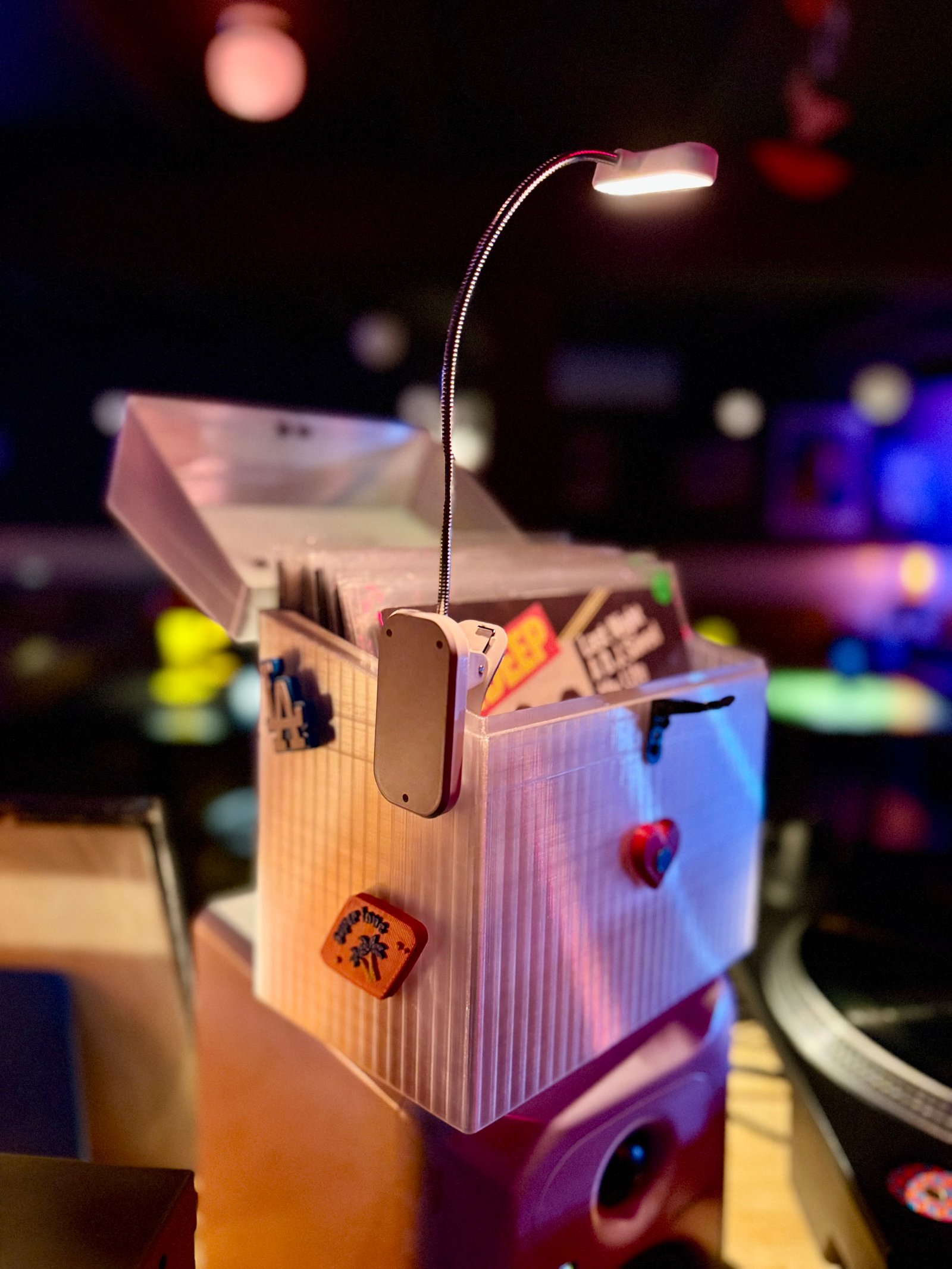
Materials. PETG for the structure, which matters more than it sounds. PETG carries the weight of a full box without bowing, handles humidity better than PLA, and does not go brittle in the cold — relevant if records ride in a car boot in winter.
Capacity. Around 50 records. As above, that is a deliberate ceiling rather than a limitation: a full box stays at a weight you will actually pick up.
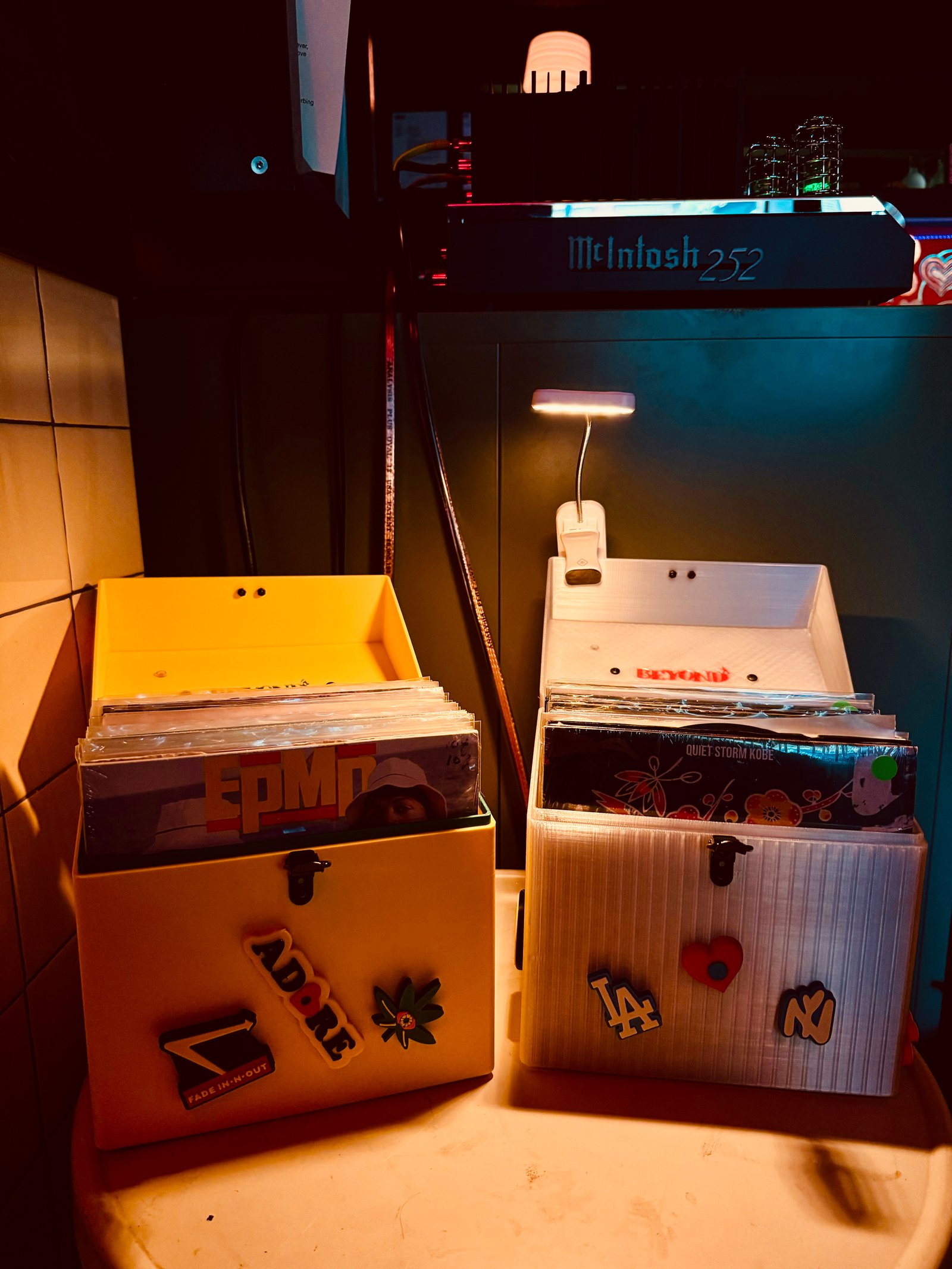
Translucency. The clear version is the genuinely useful idea here. You can see what is in a box without opening it, and at a gig with a clip-on light the contents stay readable in a dark booth. The yellow is the same box in a colour that is easier to spot in a stack.
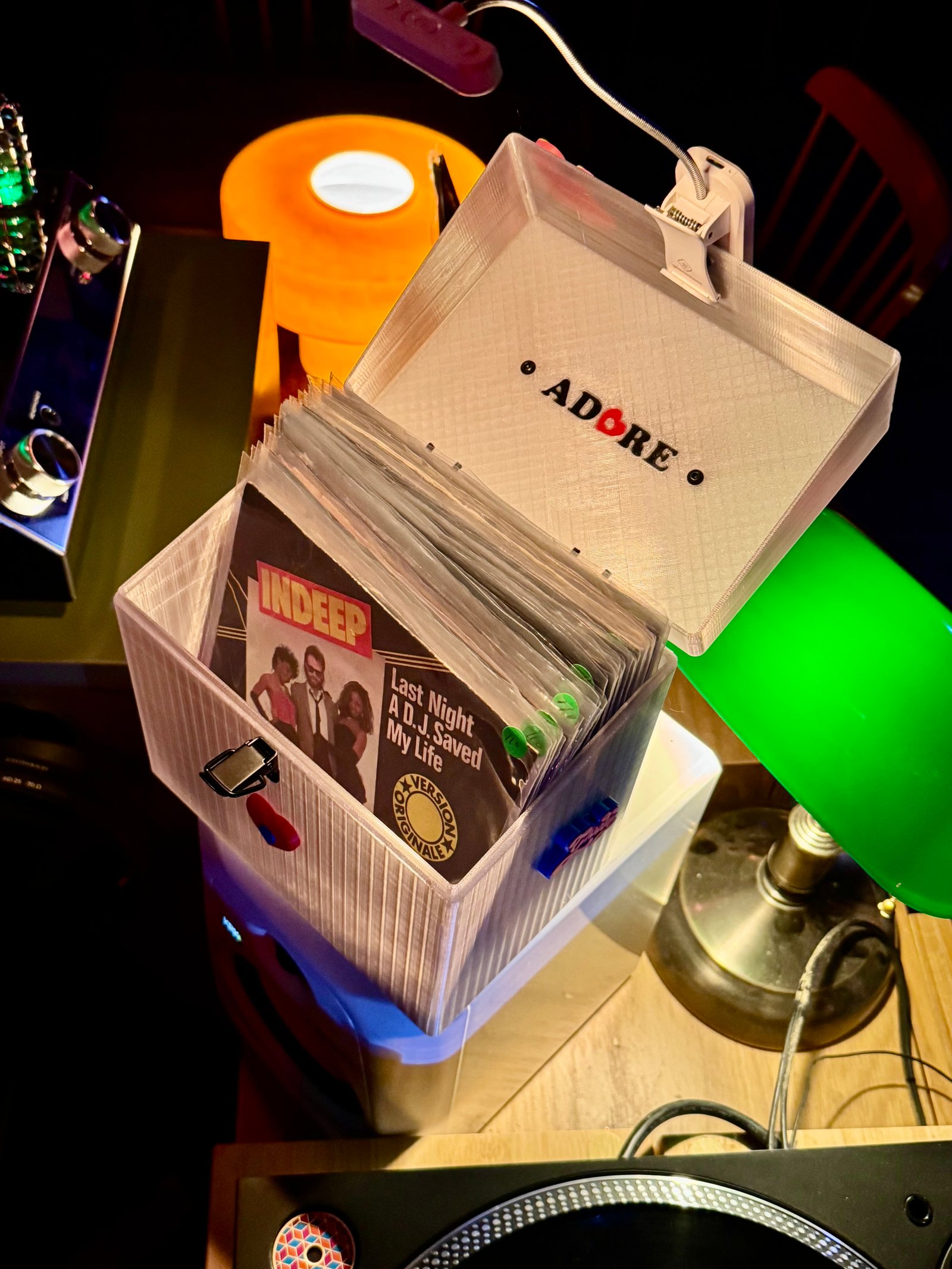
Customisation. Because each box is printed individually, a name, label or DJ handle can be built into the design rather than stuck on as a label. Practically, this solves the identical-boxes problem: five unlabelled boxes on a shelf all look the same at 2 a.m.
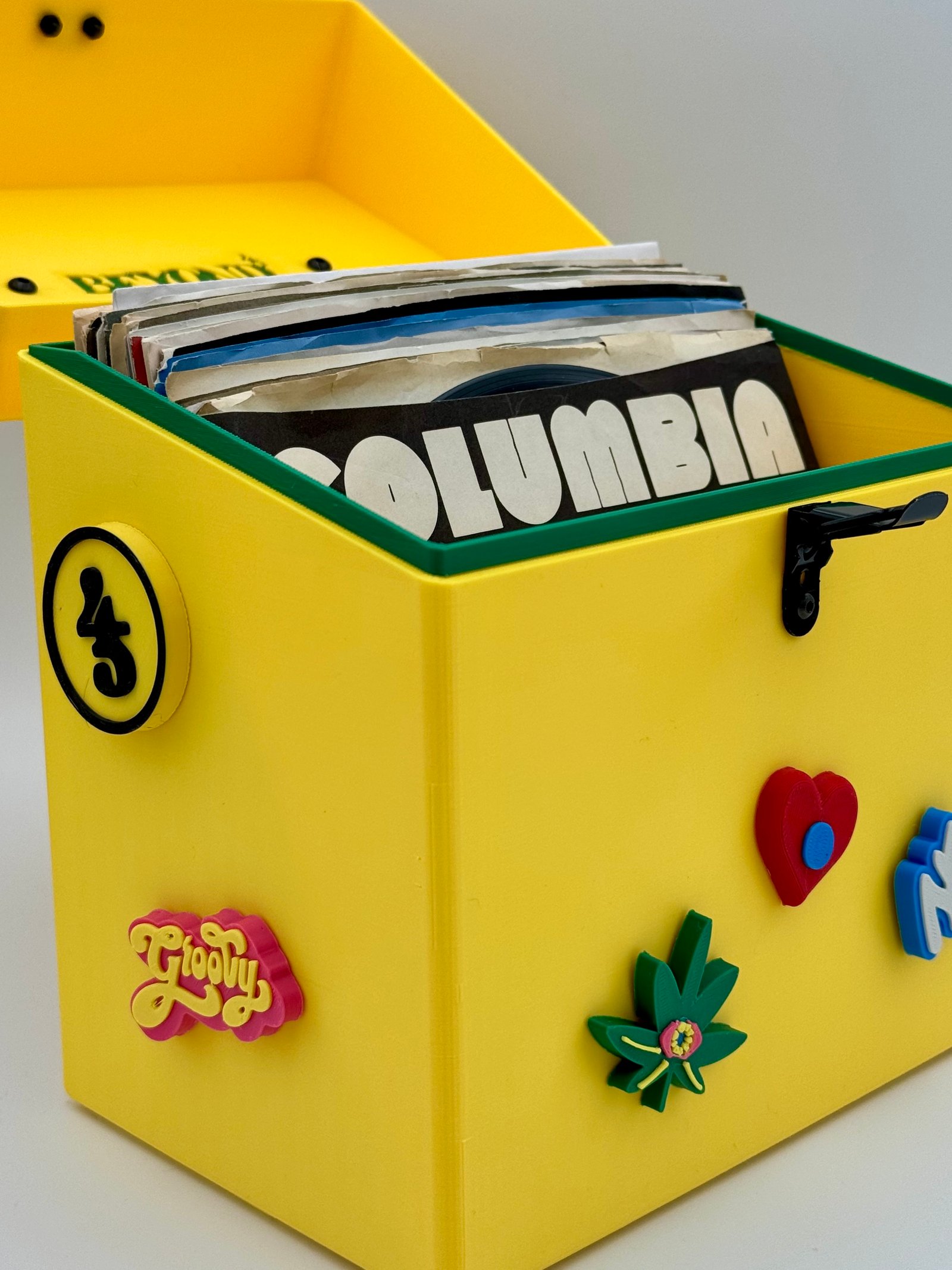
What to expect. Printed to order, so there is a lead time rather than same-day dispatch. Layer lines are visible up close — that is the nature of the process, not a defect. At roughly $75 it sits between a wooden crate and a flight case in price.
Who it suits: DJs carrying 45s to gigs who want something lighter than a flight case; collectors who want storage that looks deliberate in a listening room; anyone who has already outgrown two cardboard boxes.
Who it does not: if the collection lives permanently on a shelf and never moves, a $15 cardboard box does the same job. Pay for durability only if the box actually travels.
Where to find them: 3D Printed 7-Inch Vinyl Record Storage Box on Etsy. If you are also sorting out your spindle adapters, see our 45 RPM adapter guide.
How to Organise Once You Have the Boxes
Storage hardware only solves half the problem. A system you will actually maintain solves the other half.
Sort by use, not by alphabet. For DJs, the useful division is by set — the records currently in rotation, the ones resting, and the archive. Alphabetical sorting is for collections you browse, not collections you play.
Keep 10 percent free. A box packed to the walls means you stop filing things properly, because putting a record back requires forcing it. Leave room and the system survives.
Sleeve everything. Poly outer sleeves cost pennies each and eliminate the shelf-wear problem entirely. This matters more for 45s than LPs because picture sleeves are thinner and rub against each other more.
Store vertically, always. Stacked flat, the records at the bottom carry the weight of everything above them. Vertical storage is the single most important rule for any format.
Label the outside. Whether printed into the box or written on tape, being able to identify a box without opening it is the difference between a system and a pile.
For the full picture on humidity, sleeves and long-term care, see our guide to storing vinyl records properly.
The Bottom Line
For a collection that stays home, a cardboard 45 box at $15 is honestly sufficient — spend the difference on records. For a collection that travels, the calculation changes: cardboard fails within a year, and the replacement cost plus the sleeve damage adds up faster than a durable box would have.
Buy for how the records actually move, not for how large the collection might one day be. And whichever box you land on, the rules that preserve the records are the same: vertical, sleeved, snug, and somewhere you can see what is inside.
SH
SH is a New York–based designer who DJs vinyl and built 45 Mix Trackr after spending too many hours identifying his own mixes by hand. He records, edits and publishes mixes every month, and writes these guides from that workflow. More about 45 Mix Trackr
// Try it
Identify your DJ mix
Upload any audio or video mix and get a full tracklist with song titles, artists, and album covers in minutes.
Identify a mix →